
Why Grass-Fed Spleen Became My Iron Supplement
What repeated low ferritin taught me about heme iron
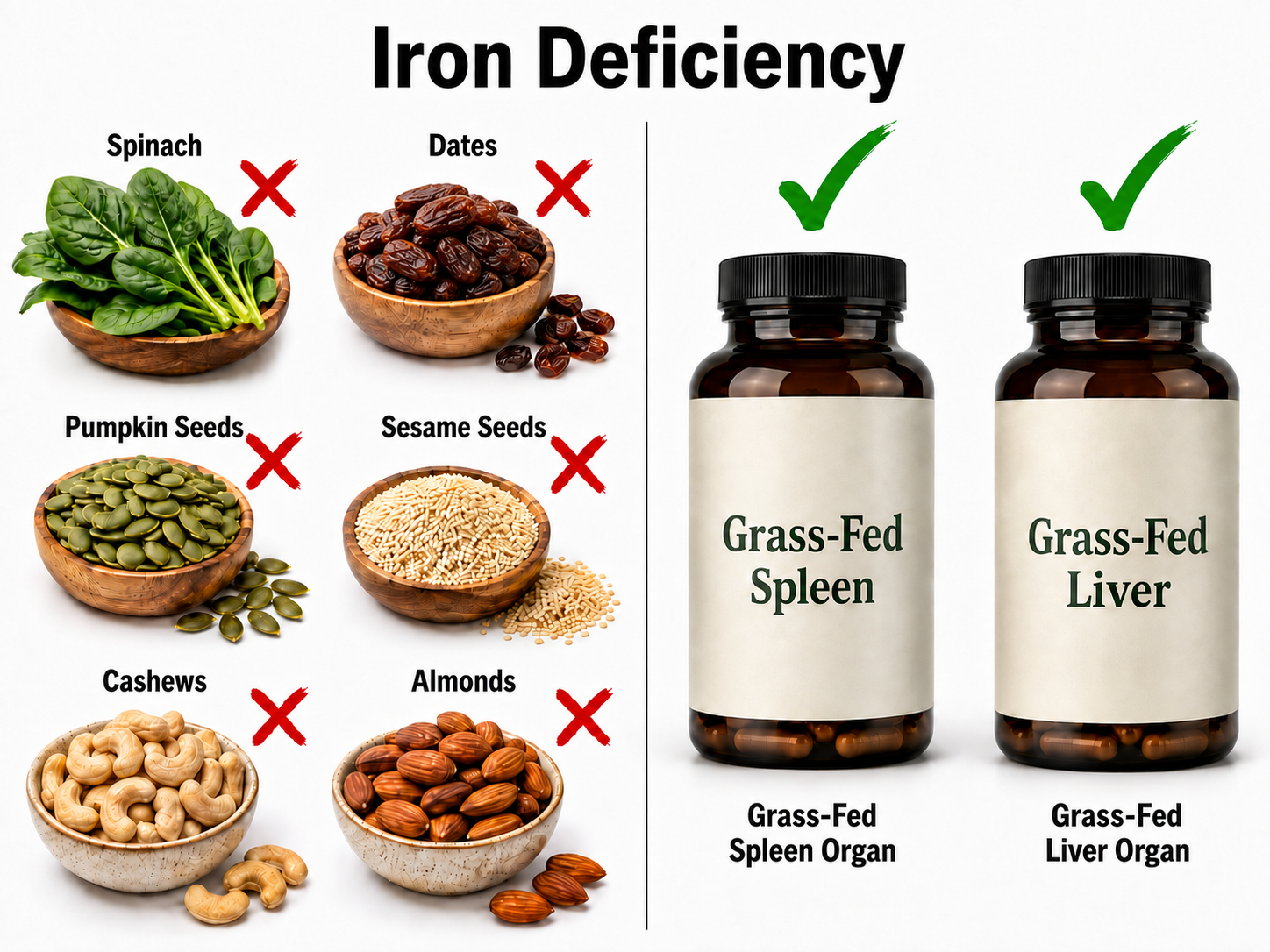
Iron deficiency is common. Articles about iron deficiency are even more common. Search for it and you will find endless advice telling you to eat spinach, add some raisins, take an iron tablet, or buy a liquid iron supplement.
My experience made me question that whole approach.
For more than a year, I had blood work done several times, and the same problem kept appearing: my iron was low and my ferritin was low. Ferritin is important because it reflects the iron your body has stored. So this was not one strange blood test. The pattern kept repeating.
I spoke with my holistic doctor about it. Her immediate recommendation was liquid iron. She prefers liquid supplements because she believes they are often easier to absorb, and in many situations I understand that reasoning.
But with iron, I eventually came to believe the bigger question was not whether my supplement was liquid, a capsule or a tablet.
The question was: What form of iron was I actually giving my body?
I Tried the Iron. My Blood Test Improved. I Didn't.
I took the liquid iron.
And yes, it worked in one sense. My iron number increased.
But I did not like the way I felt on it. I developed headaches, and increasing a laboratory number while feeling worse did not exactly feel like a victory.
I am certainly not the only person who struggles with conventional iron preparations. A systematic review and meta-analysis involving 43 randomized controlled trials and 6,831 adults found that ferrous sulfate significantly increased gastrointestinal side effects compared with both placebo and intravenous iron. PubMed
Different oral iron products have different tolerability profiles, but problems such as nausea, abdominal discomfort, constipation and other gastrointestinal effects are well recognized. PubMed
That experience sent me in a different direction.
I started looking at heme iron.
Iron Is Not Just Iron
This distinction changed the way I looked at iron completely.
There are two major forms of dietary iron: heme iron and non-heme iron.
Heme iron is found primarily in animal tissues, particularly in hemoglobin and myoglobin. Non-heme iron is the form found in plant foods and is also the form used in many conventional iron preparations.
And these two forms do not behave identically in the digestive system.
A classic review of iron nutrition reported absorption of approximately 15 to 35 percent for heme iron, compared with roughly 2 to 20 percent for non-heme iron, depending heavily on iron status and the composition of the meal. PubMed
Another review describes heme iron from meat as being absorbed more efficiently than inorganic dietary iron and notes that substances that strongly change the absorption of inorganic iron have relatively little effect on heme absorption. PubMed
That matters.
The absorption of non-heme iron is strongly influenced by what accompanies it. Phytates, polyphenols, tannins and several other dietary components can reduce its availability. Heme iron is far less influenced by these factors. Review
So when someone tells me that nuts, seeds, legumes or raisins “have iron,” my response today is simple:
Having iron on a nutrition label and efficiently absorbing that iron are not the same thing.
I am not saying plant iron has zero value. It does not. I am saying that when I was already deficient and repeatedly showing low ferritin, I did not want to build my strategy around the form of iron with the more unpredictable absorption.
I wanted heme iron
Why I Chose Spleen Instead of Liver
Most people who know anything about organ meats immediately think of liver.
Liver is nutritious, and it contains iron.
But when I specifically started looking for an organ naturally concentrated in iron, spleen stood out dramatically.
USDA-derived nutrient data list raw beef spleen at approximately 44.6 mg of iron per 100 grams. Nutrient data
That is an extraordinary concentration of iron.
And it makes biological sense when you remember what the spleen does. The spleen is heavily involved with blood. It filters blood and participates in the removal and recycling of aging red blood cells.
So instead of taking another isolated conventional iron product, I decided to try something completely different.
Grass-fed spleen.
If you can eat spleen as food, great.
I cannot.
I simply do not enjoy eating spleen, so I chose a freeze-dried grass-fed spleen supplement instead.
That became my preferred way of getting this organ into my diet.
Spleen Is Much More Than Iron
Another reason I became interested in spleen is that you are not getting a single isolated mineral.
Whole spleen naturally comes with an impressive micronutrient profile.
According to USDA-derived data, 100 grams of raw beef spleen provides approximately:
· 44.6 mg of iron
· 5.7 µg of vitamin B12
· 62 µg of selenium
· 8.4 mg of niacin
· 296 mg of phosphorus
· 429 mg of potassium
· 2.1 mg of zinc
· 18.3 g of protein
· along with riboflavin, copper and other nutrients
Source: USDA-derived beef spleen nutrient data
Vitamin B12 immediately caught my attention because B12 itself is essential for normal red blood cell formation.
Selenium contributes to important antioxidant enzyme systems.
Protein supplies amino acids rather than leaving you with nothing more than an isolated mineral.
Zinc, phosphorus, copper, riboflavin and niacin are participating in completely different aspects of metabolism at the same time.
You are not taking iron by itself. You are eating, or supplementing with, a tissue that naturally contains iron alongside many of the nutrients that came with that tissue.
Of course, a few capsules of freeze-dried spleen are not equivalent to eating 100 grams of fresh spleen. Serving size matters. I am mentioning the whole-food values to show why spleen is such an unusual organ nutritionally, not to pretend every spleen capsule contains 44 mg of iron.
Then I Repeated My Blood Work
This was the part that surprised me.
After repeatedly seeing low iron and low ferritin, I started taking the grass-fed spleen supplement.
About two months later, I repeated my blood work.
My iron had improved.
But what impressed me much more was my ferritin.
My ferritin increased tremendously compared with my previous results.
After seeing it low again and again over the previous year, I suddenly had the kind of blood work I had been trying to achieve.
And this time I felt good.
No headaches like I had experienced with the liquid iron.
No feeling that I was simply forcing a laboratory number upward.
I cannot turn my personal blood work into a randomized clinical trial. It is one person's experience.
But I also cannot ignore what happened to me.
I tried conventional supplemental iron. My number moved, but I disliked how I felt.
I changed my strategy to an iron-rich animal organ containing heme iron, and within roughly two months my iron and ferritin looked dramatically better.
That was enough to change what I personally use.
What I Would Do Today
If my iron and ferritin became low again today, I would not automatically reach for a conventional iron supplement.
Personally, I stay away from them.
I would first look toward heme-rich animal foods, and if I specifically wanted an organ exceptionally rich in iron, spleen would be at the top of my list.
If I could eat grass-fed spleen regularly, I would eat it.
Because I cannot, I use grass-fed spleen supplements.
If spleen were unavailable, liver would still be an excellent organ to consider.
And I would certainly not assume that eating more nuts, seeds or raisins is nutritionally equivalent simply because a chart says they contain iron. Much of that iron is non-heme, and non-heme iron is much more vulnerable to the many factors that interfere with absorption. Review
For me, the lesson was simple:
When I stopped thinking only about how many milligrams of iron I was taking and started thinking about the form of iron I was absorbing, everything changed.
Sometimes the answer is not more iron.
Sometimes it is choosing a better source of it.