
The Tiny ® Symbol That Changed How I Buy Supplements
I thought I knew how to choose supplements. Then one small symbol made me question everything.

An illustrative image of ubiquinol supplements at a 200 mg dose. Image licensed from Shutterstock.
For years, my approach was simple.
Find a supplement brand.
Try the supplement.
If you get good results, stick with it.
That’s it.
I thought this was a sensible way to buy supplements. A company’s reputation mattered. So did the dose, the price, and the experiences of people I trusted.
Then one supplement refused to fit that logic.
It was ubiquinol.
What started as a search for better energy eventually led me to a tiny registered symbol beside an ingredient name. I had seen ® countless times before, but I had never considered what it might mean inside a supplement bottle.
That small symbol did not give me an answer.
It gave me a trail to follow.
Why CoQ10?
Coenzyme Q10, usually shortened to CoQ10, plays an important role in cellular energy production. It helps mitochondria produce the energy cells use, and human CoQ10 levels can decline with age.
That was what interested me. I was not looking for a stimulant. I wanted something connected to the way the body produces energy itself.
CoQ10 comes in two commonly discussed forms.
Ubiquinone is the oxidized form that has been available for decades.
Ubiquinol is the reduced form.
At the time, I understood ubiquinol to be the easier form to absorb, so I chose it. I did not yet understand how much the formulation itself can influence absorption.
I selected 200 mg and expected to notice the kind of steady energy other users kept describing.
Looking back, I had only researched half the story.
Something Wasn’t Adding Up
I began with a 200 mg ubiquinol product from a well-known supplement company.
I took it consistently and waited.
The dramatic change I had read about never really came.
Then I started reading more personal experiences online.
Some people described clearer thinking and more energy within days. Others said the difference became obvious during the first week.
My experience wasn’t the same.
I did not immediately conclude that ubiquinol was useless.
I wondered whether the dose was simply too low.
More Wasn’t the Answer
I kept encountering biohackers who recommended 900 mg, 1,000 mg, or even 1,200 mg a day to experience the full benefits of CoQ10.
Their evidence?
Published studies.
So I tried increasing the dose of the ubiquinol product I was already taking.
It didn’t go well.
By 600 mg, I developed severe diarrhea.
Some people suggested increasing the dose more gradually until my body adapted, eventually working toward 1,200 mg.
But something still felt wrong.
Six capsules a day… just to feel more energetic?
That made no sense to me.
Then I looked more closely at the studies behind those recommendations. One often-cited high-dose trial tested 300, 600, and 1,200 mg of CoQ10 in people with early Parkinson’s disease, followed in specialist clinics for up to 16 months.
That was a specific medical research setting. It was not evidence that a generally healthy person in his early forties should take 1,200 mg every day for the next 20 or 30 years.
I wasn’t looking for a short-term treatment protocol.
I was trying to decide what I might take every day for the rest of my life.
At the same time, other people were describing excellent results from only 200 mg.
Maybe the problem was not the dose.
Maybe I had been focusing on the wrong thing from the beginning.
The Small Pattern I Almost Ignored
While comparing different ubiquinol supplements online, I started noticing something small beside the ingredient name.
Some products simply listed “ubiquinol.”
Others included a specific ingredient name followed by a tiny ® symbol.
At first, I almost ignored it.
But the more products I looked at, the more that pattern caught my attention.
Why did some ubiquinol supplements carry a registered ingredient name while others did not?
Was it only branding?
Was it a manufacturing distinction?
Or did it point to a specific ingredient with its own research behind it?
That small symbol was enough to make me keep searching.
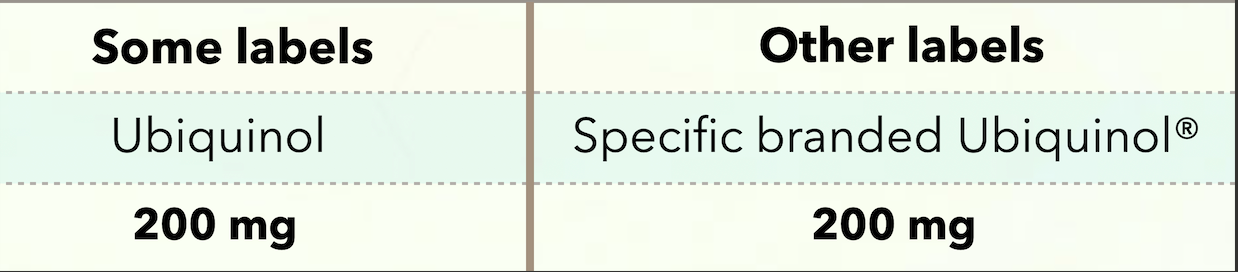
The pattern that made me curious. This simplified illustration is not a ranking of products or a claim that every branded ingredient is superior.
Following the Symbol
I searched the registered ingredient name that kept appearing on those labels.
That search led me to Kaneka.
Until then, I had paid attention to the supplement company selling the finished bottle.
Kaneka was different.
It was not the retail brand. It was the company behind the ingredient used by many different retail brands.
I had never paid attention to ingredient manufacturers before.
Now I was no longer asking only who sold the supplement.
Who actually made the ingredient inside it?
Looking Behind the Label
According to Kaneka’s published company history, the Japanese company had spent decades developing fermentation technology. In 1977, it developed naturally derived, yeast-synthesized and purified CoQ10 in its ubiquinone form.
Three decades later, it introduced the first stabilized ubiquinol product in the United States, making the reduced form of CoQ10 practical for use in finished supplements.
Kaneka supplied that ingredient to many supplement companies.
That explained the pattern I had noticed.
The retail bottles could carry different company names, while the registered ingredient inside them came from the same manufacturer.
The ® symbol was no longer just decoration.
It was pointing somewhere.
The Human Trial That Made It Worth Trying
I still needed more than a company history.
I wanted human evidence connected to the ingredient I was investigating.
While searching, I found a 12-week randomized human trial in healthy adults experiencing mild daily fatigue. Participants received 100 mg, 150 mg, or placebo.
Both ubiquinol groups reported less fatigue and sleepiness after demanding mental tasks than the placebo group. The 150 mg group also showed improvements in several additional measures.
The study was funded by Kaneka.
That mattered, and I wanted to know it. Funding does not automatically invalidate a trial, but it belongs in the picture.
The study did not tell me what I would personally feel at 200 mg.
But it showed me something important: a Kaneka-funded trial had tested ubiquinol in healthy adults at doses far below the 900 to 1,200 mg recommendations I kept seeing online.
That made it worth trying.
A Very Expensive Experiment
The second ubiquinol product wasn’t cheap.
It cost me around $154 for a one-month supply two years ago.
Still, I wanted an answer.
If I was going to spend that much money on another bottle, I wanted to know whether I was buying better marketing… or a genuinely different ingredient.
I chose a finished supplement that identified the Kaneka ingredient on its label.
The retail brand is not important here.
What interested me was the ingredient inside it.
The dose stayed exactly the same.
200 mg.
I changed nothing else in my routine.
Within less than a week, I noticed a difference in my energy.
It wasn’t the sharp stimulation you might feel from coffee.
It felt more natural.
More consistent.
More like the energy I remembered from my twenties !
I usually wake up feeling grumpy in the morning.
This time, I noticed a difference as soon as I woke up.
I also felt it during the day.
My mind felt clearer.
It wasn’t about my mood.
It was the kind of steady energy I had been hoping to experience from the beginning.
The difference was clear enough that I could no longer dismiss it as something I had imagined.
That didn’t give me a scientific answer.
But it gave me a much better question.
What was different about the ingredient behind this product?
An Unexpected Discovery
My personal experience made me keep investigating.
Then I came across something I had not expected to find.
An official court filing from a patent lawsuit involving Kaneka and a major professional supplement company.
That immediately caught my attention.
Not because I enjoy reading legal cases.
But because it suggested that there was much more behind this ingredient than I had imagined.
If the technology was valuable enough to defend in court, I wanted to understand what the companies were actually arguing about.
So I started reading the court documents.
The Questions I Never Thought to Ask
I spent hours reading court documents.
Not because I was fascinated by the legal battle.
I wanted to understand what these companies were actually fighting over.
The more I read, the more I realized the dispute was not about whether CoQ10 worked.
It was about the technology behind a specific reduced CoQ10 ingredient, including how it was produced and protected from oxidation.
Until then, I had assumed that “ubiquinol” was simply ubiquinol.
Now I found myself asking questions I had never considered before.
How was it manufactured?
How was it stabilized?
Why was this technology valuable enough to be protected by patents?
And why was Kaneka willing to defend those patents in court?
For me, the lawsuit was not the destination.
It was simply the moment that forced me to ask better questions.
From that point on, I stopped looking at supplements the same way.
Maybe I Was Comparing the Wrong Things
That experience made me reconsider the way supplements are usually compared.
Some people focus on the numbers on the label.
Others rely on the reputation of the supplement company.
Then there is the price.
A more expensive bottle can easily create the impression that it contains a more effective or higher-quality ingredient.
But that is not necessarily true.
I had relied on some of these shortcuts myself.
After everything I had discovered, another question started bothering me.
Were we even comparing the same ingredient?
A clinical trial may use a specific form produced by a specific ingredient manufacturer.
But when people buy that supplement, they may choose another product based on the dose, the brand, the price, a recommendation, or simply what feels right.
None of those things confirms that the product contains the same ingredient used in the clinical trial.
When the expected result does not come, the next recommendation is often simple: increase the dose.
But what if the dose, the brand name, and the price are not the first things we should be questioning?
What if the ingredient used in the research is not exactly the same as the one inside the bottle?
That does not automatically mean one ingredient is good and another is bad.
It means they should not always be treated as interchangeable simply because the label uses the same general name.
Before comparing milligrams, reputations, or prices, I needed to ask a more basic question:
Was I taking the same ingredient that produced the results I was trying to experience?
This Isn’t Unique to Ubiquinol
Once I started paying attention to ingredient manufacturers, I found similar examples with other supplements.
Take resveratrol supplement, for example. There are branded ingredients such as resVida® and Veri-te®, each with its own manufacturing history and body of clinical research. resVida® is better known for cardiometabolic research, including insulin sensitivity, mitochondrial metabolism, blood pressure, and liver fat. Veri-te® has been studied more for cognition and cerebrovascular function, particularly in postmenopausal women.
They are both branded trans-resveratrol ingredients. What differs is the manufacturing source and the clinical research built around each one. Their evidence should not automatically be treated as identical.
The point is that if your experience does not match the published research, check the exact ingredient, dose, population, and outcome used in that trial.
The product in your bottle may not be the same ingredient used in the clinical trials you read about.
Ubiquinol was simply the example that taught me this lesson.
The Tiny Symbol Was Only the Beginning
At the beginning of this investigation, the ® symbol looked like a small piece of branding.
By the end, I saw it differently.
In some cases, it can point to an ingredient developed around a specific goal, such as greater stability, purity, or bioavailability.
More importantly, it can give you a trail to follow.
It was a clue.
It led me to the ingredient manufacturer, the human trials, the manufacturing history, the patents, the funding, and the limits of the evidence.
But the symbol alone does not tell you everything.
You still need to investigate the ingredient behind it.
Who made it?
What was it designed to improve?
Which exact form and dose were used in the published studies?
And most importantly, does your own experience match what the research reported?
If a supplement is doing nothing for you, do not immediately assume the ingredient itself is useless.
Turn the bottle around.
Look for the ® symbol.
Search the registered ingredient name and find out what that specific formulation was developed and studied for.
Then decide whether it is worth trying for yourself.
Most importantly, this changed the questions I asked before spending money or increasing a dose.
After ubiquinol, I started looking at other supplements in my cabinet the same way.
The tiny ® symbol did not tell me what to buy.
It taught me what to investigate before buying.
Studies and Sources
The hyperlinks in the article lead directly to the principal studies and documents. The sources below are included for readers who want the full details.
1. de Barcelos IP, Haas RH. “CoQ10 and Aging.” Biology. 2019;8(2):28. doi:10.3390/biology8020028.
2. Pravst I, et al. “Comparative Bioavailability of Different Coenzyme Q10 Formulations in Healthy Elderly Individuals.” Nutrients. 2020;12(3):784. doi:10.3390/nu12030784.
3. Shults CW, et al. “Effects of Coenzyme Q10 in Early Parkinson Disease: Evidence of Slowing of the Functional Decline.” Archives of Neurology. 2002;59(10):1541–1550. doi:10.1001/archneur.59.10.1541.
4. Kaneka Nutrients. “About Kaneka Nutrients.” Company history and CoQ10 development timeline.
5. Mizuno K, Sasaki AT, Watanabe K, Watanabe Y. “Ubiquinol-10 Intake Is Effective in Relieving Mild Fatigue in Healthy Individuals.” Nutrients. 2020;12(6):1640. doi:10.3390/nu12061640.
6. U.S. District Court for the District of Delaware. Findings of Fact and Conclusions of Law in Kaneka Corporation patent litigation, Civil Action №21–209-WCB, December 20, 2024.
7. Timmers S, et al. “Calorie Restriction-like Effects of 30 Days of Resveratrol Supplementation on Energy Metabolism and Metabolic Profile in Obese Humans.” Cell Metabolism. 2011;14(5):612–622. doi:10.1016/j.cmet.2011.10.002.
8. Zaw JJT, Howe PRC, Wong RHX. “Sustained Cerebrovascular and Cognitive Benefits of Resveratrol in Postmenopausal Women.” Nutrients. 2020;12(3):828. doi:10.3390/nu12030828.
Author note: This article describes a personal experience and an investigation of published evidence. No retail supplement brand is named or promoted.