
Why I Combine MitoQ and Ubiquinol CoQ10
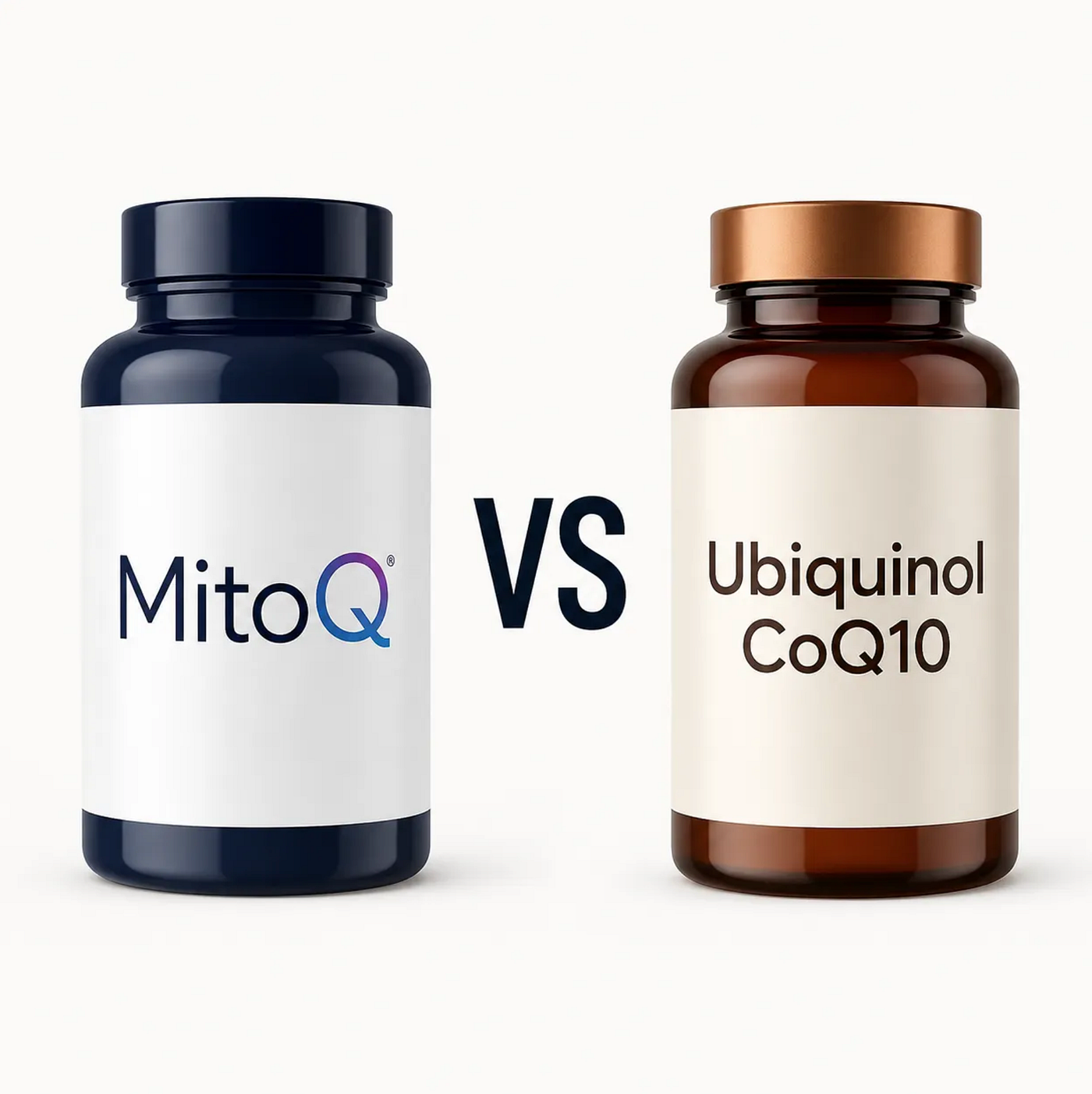
After using ubiquinol since 2018 and combining it with MitoQ for four months, I stopped asking which one is better. They work inside the same mitochondrial system, but they do different jobs.
Created by Artificial Intelligence
I use both. I like both.
I have been taking ubiquinol since 2018, after switching away from regular CoQ10. Four months ago, I added MitoQ® to my routine. I did not add it because ubiquinol had stopped working, and I did not add it because I believed MitoQ was a superior replacement. I added it because the more I investigated the chemistry, the less sense it made to treat these two supplements as competitors.
MitoQ and ubiquinol operate inside the same mitochondrial system, but they are not interchangeable. They overlap in some ways, yet each has a different role. That difference is the reason I decided to use both.
On demanding workdays, the energy I experience from this combination has been tremendous. That is my personal experience after four months, but my decision was not based on feeling alone. The published research shows a real biochemical difference between the two molecules, and once that difference is explained clearly, the logic of combining them becomes easier to understand.
MitoQ Is Not Simply Another CoQ10 Capsule
MitoQ is often described as an advanced form of CoQ10. That description is convenient, but it can also be misleading.
It may make people assume that MitoQ is simply a stronger CoQ10 supplement, or that taking MitoQ makes regular ubiquinol unnecessary.
That is not how it works.
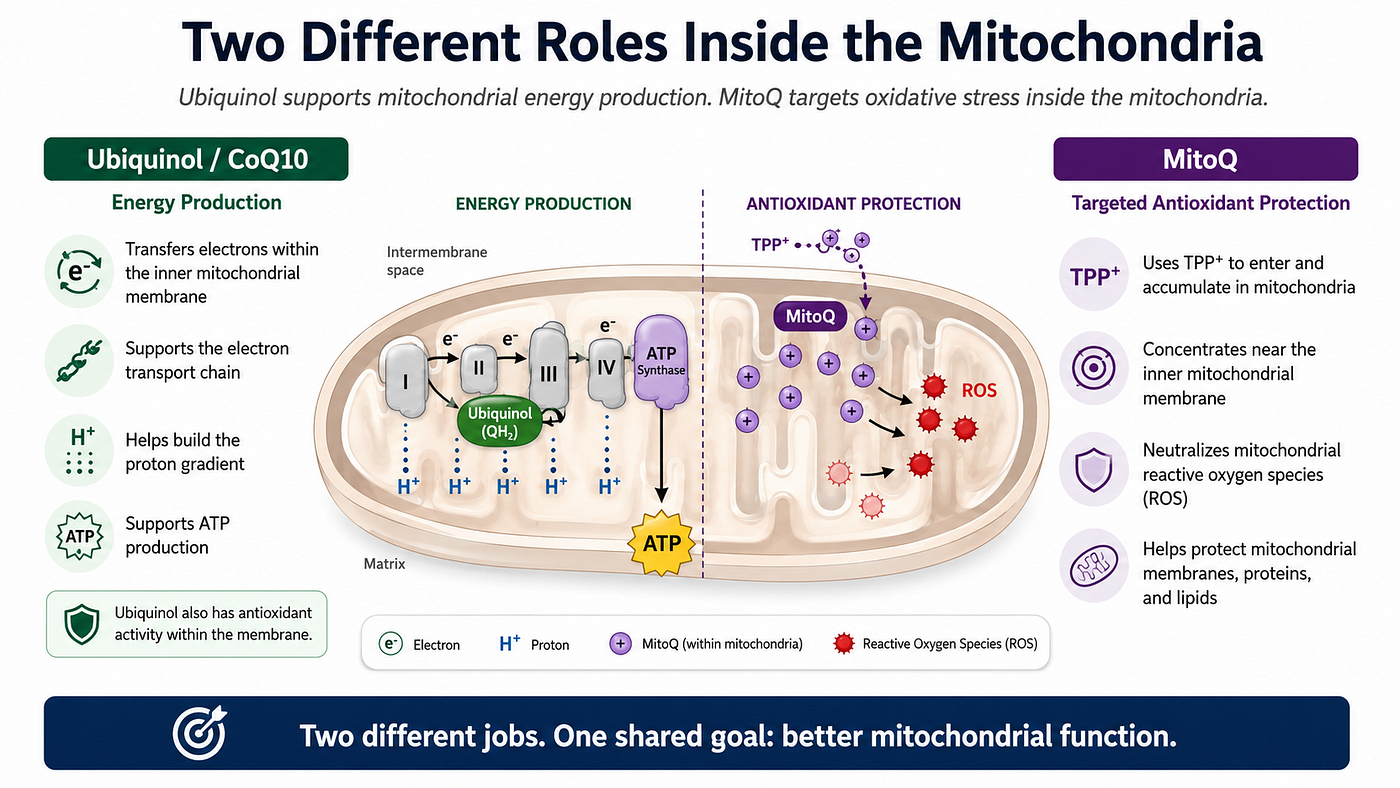
MitoQ begins with a molecule related to CoQ10, but scientists modify it by attaching it to a mitochondrial delivery system called triphenylphosphonium, usually shortened to TPP+.
The name sounds complicated, but its purpose is simple.
TPP+ carries a positive electrical charge. The inside of a functioning mitochondrion has a strong negative electrical charge. Because opposite electrical charges attract, the positively charged TPP+ helps pull MitoQ across cell membranes and into the mitochondria (Smith et al., 2003; Zielonka et al., 2017).
This is what makes MitoQ unusual. It is not simply circulating through the body as another antioxidant. It is designed to accumulate inside the structures where cellular energy is being produced.
Once there, MitoQ settles close to the inner mitochondrial membrane, the area where much of the cell’s energy-making machinery is located.
During normal energy production, mitochondria also generate reactive molecules. In controlled amounts, these molecules are part of normal biology. But when they accumulate excessively, they can attack the fats that form mitochondrial membranes. This damaging process is called lipid peroxidation.
Inside the mitochondria, MitoQ can be converted into its antioxidant form and help limit these oxidative reactions close to where they begin (James et al., 2007).
My simplest way of thinking about it is this:
Mitochondria are working engines. MitoQ is designed to enter those engines and provide antioxidant protection close to the machinery while it is running.
That targeting mechanism is what makes MitoQ different. It is not simply a larger or stronger dose of ordinary CoQ10.
What Ubiquinol Does Differently
Ubiquinol is the active, reduced form of CoQ10, but its importance goes far beyond the word “reduced.”
CoQ10 is a natural part of the mitochondrial energy-producing system.
Inside the inner mitochondrial membrane, CoQ10 continually changes between two forms: ubiquinone and ubiquinol. This cycle allows it to collect and transfer electrons through the mitochondrial respiratory chain.
The respiratory chain is the sequence of reactions mitochondria use to convert energy from food into ATP, the usable form of energy that powers our cells.
CoQ10 collects electrons from the first stages of this system, mainly complexes I and II, and carries them toward complex III. This electron movement helps mitochondria build the electrical and chemical gradient needed by ATP synthase, the molecular machinery that produces ATP.
In simpler terms, CoQ10 helps move energy through the mitochondrial production line.
Ubiquinol also works as an antioxidant. However, antioxidant protection is not its only purpose. It belongs to the natural electron-transfer system itself.
That is the central difference:
Ubiquinol participates in the mitochondrial process that produces cellular energy. MitoQ is engineered to enter mitochondria and provide concentrated antioxidant protection inside that same environment.
They operate in the same cellular system, but they do not perform one identical job.
Ubiquinol supports the energy-production system. MitoQ targets oxidative stress inside that system.
The Major Study That Settled the Question for Me
The clearest evidence I found came from a biochemical study published in the Journal of Biological Chemistry. The researchers compared mitochondria-targeted MitoQ with untargeted ubiquinones and examined how each molecule interacted with the mitochondrial respiratory chain.
Here, “respiration” does not mean breathing through the lungs. Mitochondrial respiration is the chemical process cells use to move electrons, consume oxygen and produce ATP.
The study found that MitoQ was rapidly converted into its antioxidant form and protected mitochondria against several types of oxidative damage. That confirmed that its targeting system was doing what it was designed to do.
But the researchers also tested a different question: could MitoQ replace the natural CoQ10 pool when that pool was missing? The answer was no. MitoQ could not restore normal mitochondrial respiration because complex III did not process it efficiently enough to let it perform the full electron-carrying role of natural ubiquinone and ubiquinol (James et al., 2005).
That result matters because a true replacement for CoQ10 would need to do more than control oxidation. It would need to carry electrons through the respiratory chain and support ATP production as part of the system itself.
MitoQ did not do that. Its strength was targeted antioxidant protection, not replacing the natural CoQ10 pool.
This is not a competition between two bottles. It is a division of work. Ubiquinol supports electron transfer and ATP production. MitoQ is engineered to accumulate inside mitochondria and address oxidative stress close to the energy-producing machinery.
That is why I take both. I am supporting the mitochondrial energy system while also adding a molecule designed to protect that same environment. The tremendous energy I experience from the combination is personal, but the biochemical logic behind the combination is clear.
Created by Artificial Intelligence
My Routine After Four Months
I do not take MitoQ every day. I use it strategically.
On an ordinary day, I take 200 mg of Kaneka Ubiquinol® CoQ10. On a day when I know I have a large amount of work, a long schedule or a demanding mental workload, I add 10 mg of MitoQ and take between 200 and 400 mg of ubiquinol that day.
The MitoQ product I use contains 5 mg per capsule, so 10 mg means two capsules.
This is the routine I reached after four months of testing the combination. I am not presenting it as a dosage chart for everyone. I am explaining exactly what I take, when I take it and why I continue using it this way.
I pay attention to my own response rather than automatically following a company schedule or copying a biohacker’s routine. A supplement may have one standard label direction, but the way it feels in real life still matters.
How I Take MitoQ
I take MitoQ in the morning on an empty stomach, at least 30 minutes before food.
Unlike ubiquinol, MitoQ does not need a fatty meal or added oil for absorption. The official product instructions recommend two capsules with water before eating, and the active ingredient is listed as 10 mg of MitoQ® as mitoquinol mesylate (MitoQ, 2026).
For me, morning is the only sensible time. MitoQ gives me a noticeable increase in energy, and I do not want to push that effect toward the evening. On regular days, when I do not need the extra push, I leave it out.
Ten milligrams is enough for me. The entire point of MitoQ is mitochondrial targeting, so I do not assume that a larger number automatically means a better result.
How I Take Ubiquinol
Ubiquinol is fat-soluble, so I take it with food. I also have a sensitive stomach, and taking it with a meal feels better for me.
Some people may tolerate it differently. My rule is simple: listen to your body. A supplement can look perfect on paper and still feel wrong when you take it at a particular time or in a particular way.
My regular dose is 200 mg. On demanding days, especially when I add MitoQ, I may use between 200 and 400 mg of ubiquinol.
Why I Do Not Take 1,000 mg of CoQ10
I explained the full reason I do not chase giant CoQ10 doses in my previous article, The Tiny ® Symbol That Changed How I Buy Supplements. [INSERT LINK TO THE PREVIOUS ARTICLE]
My position is straightforward: before increasing the dose, fix the ingredient.
A large number on the front of a bottle does not prove that the product is being absorbed well. The form matters. The formulation matters. The carrier oil matters. Stability matters. The raw ingredient matters.
In a randomized crossover trial in older men, 200 mg of ubiquinol increased CoQ10 status more effectively than the same 200 mg dose of ubiquinone (Zhang et al., 2018). Separate formulation research also shows that CoQ10 absorption can vary substantially depending on the way a product is manufactured and dissolved (López-Lluch et al., 2019).
That is why I refuse to use 1,000 mg as a substitute for quality. If someone needs an enormous routine dose just to feel anything, my first question is not how to increase it again. My first question is whether the ingredient is potent, stable and properly absorbed.
Very high CoQ10 doses do appear in clinical studies for specific diseases. That is a separate discussion. I am talking about the biohacking trend of treating 1,000 mg as a normal daily starting point for energy.
For my own routine, 200 to 400 mg of a carefully selected ubiquinol product is enough. I choose the ingredient before I choose the dose.
The Rule I Follow When Buying Ubiquinol
When it comes to CoQ10, especially ubiquinol, I only buy a supplement that clearly states it uses Kaneka Ubiquinol®.
That does not mean I am loyal to one finished supplement company. Kaneka manufactures the branded ubiquinol ingredient, and many different supplement companies use that ingredient in their own capsules or softgels. My loyalty is to the raw ingredient, not the design on the front of the bottle.
I look for the words Kaneka Ubiquinol® or the Kaneka quality seal on the label. Kaneka states that its ubiquinol ingredient is used by more than 200 brands and is backed by more than 85 human clinical studies (Kaneka Nutrients, 2026).
The regulatory language also needs to be accurate. Kaneka Ubiquinol is not “FDA approved” in the way a pharmaceutical drug is approved. The FDA inventory records a New Dietary Ingredient notification for Ubiquinol, Kaneka QH, submitted by Kaneka Corporation in 2005 (FDA, 2026).
Europe does not issue a special branded “Kaneka licence” that should appear on the bottle. The European Union handles novel food authorisations through its Union list, and those authorisations are generally attached to the authorised ingredient and conditions of use rather than presented as a special licence for a brand (European Commission, 2026). I would rather use the correct regulatory language than repeat an approval title that does not exist.
Finding Genuine MitoQ Is Easier
Ubiquinol requires comparison because many companies sell supplements under that category. MitoQ is different.
MitoQ® is not a generic name for every mitochondria-focused form of CoQ10. It is the registered, patent-protected ingredient whose active compound is mitoquinol mesylate. The official label identifies MitoQ® as a trademark of Antipodean Pharmaceuticals Inc., and the company states that it was discovered and designed in New Zealand (MitoQ, 2026).
That means I do not search for ten different “MitoQ brands” and compare which one is authentic. A company may sell a mitochondrial antioxidant, a modified CoQ10 product or a supplement using similar language, but that does not make the ingredient MitoQ.
When I buy it, I check that the label says MitoQ® and lists mitoquinol mesylate. That is the specific ingredient I am looking for.
With ubiquinol, I verify Kaneka Ubiquinol®. With MitoQ, I verify the patented MitoQ® ingredient.
Why I Do Not Take MitoQ Every Day
The company recommends regular use. My own routine is different.
I save MitoQ for days when I know I will need more energy, concentration and endurance. On quieter days, I continue taking my regular 200 mg of ubiquinol without MitoQ.
This is not because I dislike MitoQ. I like it very much. It is because I respect the strength of the effect I feel from it.
When a supplement produces a strong, noticeable result, my response is not automatically to take more or use it every day. My response is to find the smallest routine that gives me the result I want without interfering with my sleep.
Ten milligrams on demanding days has done that for me.
So Which One Is Better?
I think that is the wrong question.
MitoQ and ubiquinol are not fighting for one position in my supplement cabinet.
Ubiquinol is my daily foundation. MitoQ is my targeted addition.
The natural CoQ10 system helps move electrons through the mitochondrial respiratory chain and supports ATP production. MitoQ is engineered to concentrate inside mitochondria and provide antioxidant activity close to the inner membrane, where much of that energy production takes place.
They work in the same environment, but they perform different jobs. That is why, after four months of taking both, I have no intention of choosing between them.
On regular days, I use 200 mg of Kaneka Ubiquinol® CoQ10 with food.
On demanding days, I add 10 mg of MitoQ® on an empty stomach and use between 200 and 400 mg of ubiquinol with food.
The combination gives me tremendous energy. It is not a routine I copied from someone else. It is the routine I reached after years of using ubiquinol, four months of combining both supplements and paying close attention to how my body responded.
What Comes Next: PQQ
There is one more part of my mitochondrial routine that I have deliberately kept out of this article: PQQ.
I also take PQQ with this combination, but it deserves a separate investigation. PQQ is often discussed in relation to mitochondrial biogenesis, which means the process through which cells increase or renew their mitochondrial machinery. That claim needs to be examined carefully, especially in human research.
In my next article, I will examine the human and mechanistic research on PQQ, why I combine it with CoQ10, and where L-carnitine, vitamin D3 and vitamin K2 fit into my broader mitochondrial routine.
That subject needs its own space.
So what ?
MitoQ did not replace my ubiquinol.
It gave me another reason to continue taking it.
The research shows that MitoQ and the natural CoQ10 pool behave differently inside mitochondria. CoQ10 is part of the electron-transfer system that supports ATP production. MitoQ is deliberately targeted into mitochondria to provide antioxidant protection close to that energy-producing machinery.
That distinction is the entire reason I use both.
I do not chase 1,000 mg doses. I choose the ingredient carefully, use the dose that works for me and pay attention to timing.
After four months, my routine is simple: ubiquinol is the foundation, MitoQ is the targeted addition, and the energy speaks for itself.
Studies and Sources
1. European Commission (2026). Union list of novel foods. European Commission, Food Safety. Open source 2. Food and Drug Administration (FDA) (2026). New Dietary Ingredient Notification Inventory. Entry 328: Ubiquinol (KANEKA QH), Kaneka Corp. Open source 3. Hosoe, K., Kitano, M., Kishida, H., Kubo, H., Fujii, K. and Kitahara, M. (2007). Study on safety and bioavailability of ubiquinol (Kaneka QH) after single and four-week multiple oral administration to healthy volunteers. Regulatory Toxicology and Pharmacology, 47(1), 19–28. Open source 4. James, A.M., Cochemé, H.M., Smith, R.A.J. and Murphy, M.P. (2005). Interactions of mitochondria-targeted and untargeted ubiquinones with the mitochondrial respiratory chain and reactive oxygen species. Journal of Biological Chemistry, 280(22), 21295–21312. doi:10.1074/jbc.M501527200. Open source 5. James, A.M., Sharpley, M.S., Manas, A.R.B., Frerman, F.E., Hirst, J., Smith, R.A.J. and Murphy, M.P. (2007). Interaction of the mitochondria-targeted antioxidant MitoQ with phospholipid bilayers and ubiquinone oxidoreductases. Journal of Biological Chemistry, 282(20), 14708–14718. doi:10.1074/jbc.M611463200. Open source 6. Kaneka Nutrients (2026). About Kaneka Nutrients and Kaneka Ubiquinol®. Official company information. Open source 7. López-Lluch, G., del Pozo-Cruz, J., Sánchez-Cuesta, A., Cortés-Rodríguez, A.B. and Navas, P. (2019). Bioavailability of coenzyme Q10 supplements depends on carrier lipids and solubilization. Nutrition, 57, 133–140. Open source 8. MitoQ (2026). MitoQ Pure: ingredients, dosage instructions, trademark and origin information. Official product page. Open source 9. Mizuno, K. et al. (2020). Ubiquinol-10 intake is effective in relieving mild fatigue in healthy individuals. Nutrients, 12(6), 1640. doi:10.3390/nu12061640. Open source 10. Rossman, M.J. et al. (2018). Chronic supplementation with a mitochondrial antioxidant improves vascular function in healthy older adults. Hypertension, 71(6), 1056–1063. doi:10.1161/HYPERTENSIONAHA.117.10787. Open source 11. Smith, R.A.J., Porteous, C.M., Gane, A.M. and Murphy, M.P. (2003). Delivery of bioactive molecules to mitochondria in vivo. Proceedings of the National Academy of Sciences, 100(9), 5407–5412. Open source 12. Zhang, Y., Liu, J., Chen, X.Q. and Chen, C.Y.O. (2018). Ubiquinol is superior to ubiquinone to enhance coenzyme Q10 status in older men. Food & Function, 9(11), 5653–5659. doi:10.1039/C8FO00971F. Open source 13. Zielonka, J. et al. (2017). Mitochondria-targeted triphenylphosphonium-based compounds: syntheses, mechanisms of action and therapeutic and diagnostic applications. Chemical Reviews, 117(15), 10043–10120. Open source